
Tanks a lot
Sometimes you get a shoot that’s an absolute pleasure to be part of. For me, they’re often the one-dayers. There’s something quietly satisfying about getting up early, putting in a long day, and then crashing in your own bed that same night. Maybe that’s just middle age tapping me on the shoulder.
As the series winds down production and heads into post, there are only a handful of shoots left—three of which were one-day jobs back in British Columbia.
The first is for a species of fish I can’t name (thanks, NDA) in a river I also can’t name. It’s a fun day where I’ll be working as the dive supervisor. There are several people enter the water on this shoot, so it’s important we do so under Canadian commercial diving regulations—as every production of this nature absolutely should.
Filming a species in a single day is luxury, but it is achievable with a realistic shot list, solid team, and an irresponsible amount of snacks. It does crank up the pressure, and the margin for error is basically zero, but if you plan well and stay realistic with your goals, a good crew can do a lot with a modest budget.
The second day was an ocean dive shoot, focusing on people in a specific underwater environment. I love this kind of thing. What originally pulled me into this line of work wasn’t wildlife—it was people and their relationship to their environment. In most cases for me, that environment is underwater. Visually, I find it the most interesting, exciting, and compelling. Story-wise, there are always fascinating reasons why people put themselves through the trouble of being underwater: inside a kelp forest, on deep sponges, among coral, inside a shipwreck—you name it.
Day three was topside. Directing one-dayers is always a joy when you’ve got an interesting subject and a good crew. And working with Matt Hood is always a pleasure—he’s an excellent cinematographer, does whatever needs doing, and is great company.
This shoot was offshore on a small boat near Victoria. We had two researchers onboard, and it’s always entertaining watching experts geek out about their niche. The whole day went shockingly smoothly. I know, right? No kerfuffles. No hurricanes, wildfires, deaths, broken cameras, or unexpected shenanigans. Possibly a first for me on this series.
Tank shoots, however… whole different story.
For the uninitiated, we’ll often film certain animals in controlled environments—like filming a scallop in a saltwater aquarium. It lets us control the animal’s position, lighting, surroundings, camera angles, and it means no diving. Less money, more time, more control.
This entire series—come wind, rain, wildfire, or community tragedy—I’ve never been too stressed. I’ve stayed relatively chilled. Sure, there have been some strikes and gutters, but overall I’ve been a little Fonzie.
Tank shoots bring out the worst in me. My SWPM (swear words per minute) skyrockets. I want to break things. And I absolutely never want to see whatever I’m filming ever again.
The tank shoots I do tend to be impromptu—more of a “cost-saver” than an ideal storytelling tool. Facilities and circumstances are rarely perfect. Tanks are small, time is limited, I’m usually doing most of it myself or with one other person, and there’s no proper studio. Could be outdoors. Could be in a friend’s garage.
As such you get mixed results. Sometimes you get the shot. Other times your resources simply can’t meet expectations.
The goals for tank shoots are always hyper-specific. “Can you get a scallop spawning while riding a tiny bicycle?” My success rate for these sorts of things is about 40 per cent. Or, as I like to say—“You’ll get what you get.” I might get the scallop on the bicycle, and maybe I’ll get it spawning, but both at once? Not happening on my watch, not with such limited resources.
“Scallop on a bicycle” is just an example and in no way reflects what I’ve actually been filming. Which is nowhere near as interesting.
Tank filming takes serious husbandry. Keeping a saltwater species alive, healthy, and unstressed in a tiny tank—on land—is no minor feat. Making it look natural, and often matching an existing ocean shot, is even harder.
Tank shoots bring a bit of a moral question too—is it authentic storytelling? Honestly, it can be. The behaviour is real. The story is real. We’re simply “cheating” the environment to increase our chances. Like a documentary using re-creations—the story is still true; we’re just using another tool to tell it.
Many wildlife shows use this method, and most viewers would be floored to know how often it happens. Done well, you’ll never notice. Movie magic, right?
So what turns me into a moany, swearing English sailor? It’s finicky. That’s the word. And my patience wasn’t built for finicky. Water temperature must be precise—tough when you’re not pumping in fresh seawater. Salinity has to be spot on. Clarity too—difficult depending on species and behaviour (scallop bicycles kick up silt, after all). You need holding tanks for backup animals—also requiring fresh seawater, care, and feeding. You need light, air, pumps, cleaning, and food.
You must clean the tank with materials safe for the animals, dress the set so the animal is comfortable and you get the shot, and make sure everything can survive overnight or multiple days. Lights can’t overheat the water and some species hate, or react badly to light entirely.
And this is all before cameras even roll. Cheap fish tanks have terrible glass—offset the lens by five degrees and everything distorts. That kills most of your shooting angles, meaning you might get lousy footage, or you have to politely convince your scallop to pedal its bicycle towards camera.
Macro filming adds its own cruelty. A 360 mm macro lens has a depth of field thinner than my patience on day six. The slightest movement—a fraction of a millimetre—and the shot goes out of focus. Combine this with water movement and you get a steady stream of profanity.
Lighting adds another layer. Many marine species are sensitive to light. Our hypothetical scallop may ride best at night, but we need bright light to match a previous ocean shot.
It’s all a balance. As is life, the Force, and everything, apparently. One degree too warm and the water triggers spawning; too much light and the animal shuts down; too little and the footage is useless.
Tank shoots are never given enough time. The attitude is always “It’s controlled, so it’ll be quick.” Or “It’s just a scallop, it won’t take long”. Or the old classic “All you gotta do is put a scallop in a tank and film it ride a bicycle”. Reality says otherwise. Animals need time to settle. Tanks need time to settle. You need time to learn how the species behaves in this fake environment. My last tank shoot was six days, and by the end I felt like I only just understood enough to get started. Give me another week and I’d have nailed it. As it stood, I pulled off 40–50 per cent of the shot list—and honestly, they should count themselves lucky given what I had to work with.
This lack of time is the most frustrating part and the birthplace of peak moany Englishman.
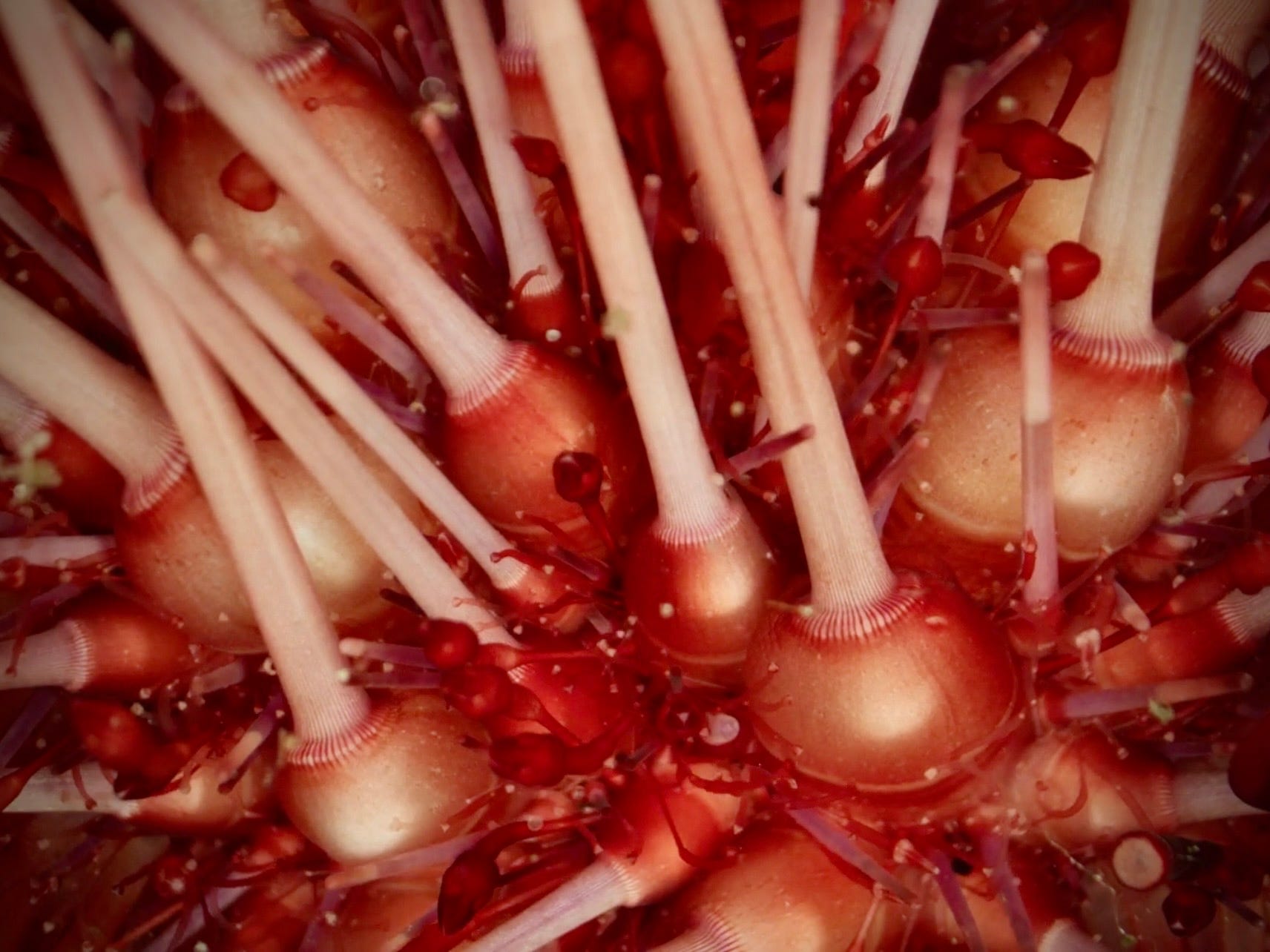
But when it works, it can be incredibly rewarding. You can capture behaviour, story, and beautiful abstract imagery in ways you simply can’t in the wild. These unusual, rarely seen visuals are what pull a viewer deeper into the story. When you find the angle, set the shot, hit record, and reveal a tiny, overlooked creature looking as magnificent as it truly is—that’s the payoff.
I’m pleased to say I have no more tank shoots on the schedule. As rewarding as they can be, they tend to be far more stressful than I’d like. Next time, I think I’ll hand them off to someone better suited—or at least someone who knows fewer swear words.